Story-Driven Escape Room Instead of Expensive Sets: How the Castle Was Built
We were showing “Chronicles of the Living Castle” to two clients over a video call. That is how we do it once an escape room is assembled: one person holds the phone, another plays, and the client on the other end watches, asks questions and says what they would do differently.
For the first ten minutes or so they sat there with serious, focused faces. Then they started talking to each other in their own language. Then they started laughing.

When the playthrough was over, I asked for feedback. On the puzzles, they said the mechanics were interesting and unusual, nothing they had come across before: what stuck with them most was having to slowly turn a sleeping dog away so it would not wake up. And they described the overall impression like this - it was engaging, the time flew by, it felt like we had just watched a movie.
A movie. Not “a hard escape room,” not “clever puzzles,” even though the mechanics were exactly what they praised. A movie.
That is precisely what I was going for. Let me explain how we got there and why our Castle is built the way it is.
Puzzles matter to a minority
Back when we ran our own venues, I watched enough players to understand one simple thing. Puzzles on their own matter to a very small share of people.
Everyone else comes for the emotion. Someone grabbed your hand in the dark - you jumped, and there is your emotion. But the strongest one comes from living through a story that actually means something.

It works the same way as film. Some big-budget movies you cannot recall the next day. And then there is a small, intimate one shot on a shoestring, and you are still retelling it to friends a year later.
The artist who moved readers to tears with drawings
There is a computer game called Syberia. Its author is the Belgian artist Benoît Sokal, who drew comics before he made games. The story goes that his art and his storylines moved his readers to tears.
Drawings and text. Not a single full-scale set, not a single square foot of rent.
Which means the emotion a person walks into an entertainment venue for is created by story. Not by scale.
Anya, a colleague of mine, was recently going through her old things, found her Syberia disc at home and wrote a post about it. We arrived at the same conclusion from opposite directions: she as the guest who played that story, me as the person who builds stories like it.

This is where I part ways with the market
Clients say: build big rooms, make it impressive. I hear it constantly. And I can see where it leads - escape rooms get more expensive every year: the sets, the floor area, the rent on that floor area.
I decided to come at it from the other side. Instead of driving up the cost of the sets, deepen the story: lots of characters, lots of small zones that hand off to each other quickly. And to keep it from costing a fortune - shrink the whole thing physically.
A story has no size. It is what you believe while you are inside it.
What a story is, if it is not “the room’s theme”
A theme is “pirates” or “medieval.” It is enough to dress a room, but not enough to produce a story-driven escape room. A story is a set of connected events arranged in a specific order to reveal an idea. The spine everything else hangs on.
The Castle has a main mission, side threads, setbacks and a final victory. Like a proper film.
And there is one requirement I set in stone: everyone has to reach the end. To make that work, the characters help unobtrusively - in a way that leaves the player certain they figured it out themselves.
A person should walk out a hero, not someone who was given the answer.
Fifteen zones and fourteen characters
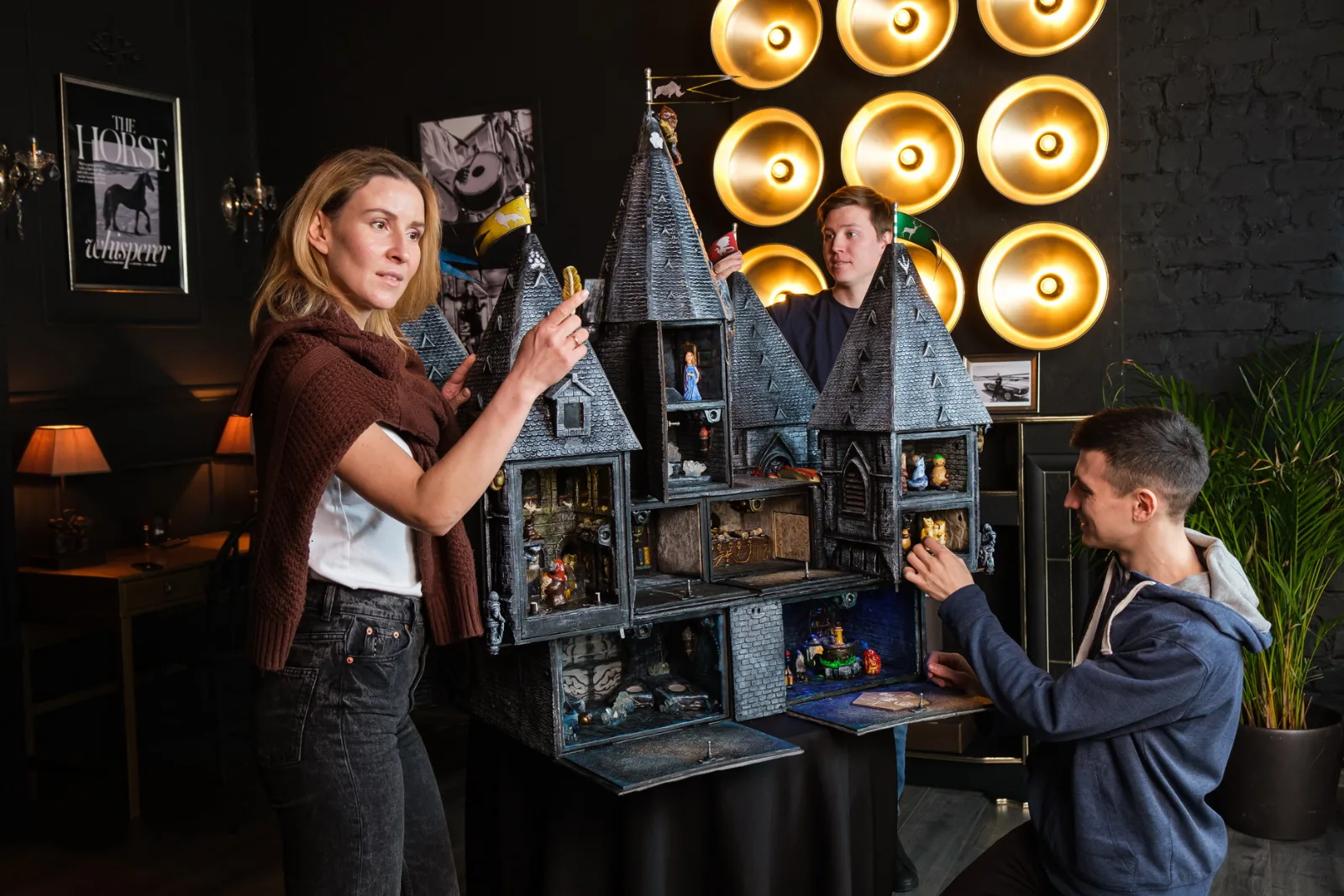
The castle itself stands at the center of the space - fifteen zones. Around it, in the corners, four more standalone story games. Fourteen characters, each with their own voice and their own personality.
Personality is not a figure of speech here. Let me show you across three zones.
Elspeth, the Potion Laboratory

An elderly witch. An aged voice, a commanding tone, and she is not glad to see guests. Touch her with the magic wand to ask something and she snaps back: “Well, don’t just stand there - get to work!”
Every character has lines written for the moment when everything in the zone is already done. That is when Elspeth breaks the fourth wall: “Why do you keep poking me? I’ve told you everything already!”
Next to her is the cauldron. You have to lower ingredient bottles into it in the right order. The bottles are fixed to the wall and slide along a groove - physically impossible to lose. On the ceiling, unlike in the other zones, there is an addressable LED strip: it shimmers as if the light were coming from the cauldron itself. Get the order wrong and the room turns red with the sound of shattering glass. Get it right and the color drifts while the cauldron bubbles.
Boris, the workshop
A big, kind craftsman, with a voice to match - the way every big, kind character in a fairy tale sounds. He is happy to see guests and asks for help: build Kai a sturdy helmet and a magic broom for the tournament. Kai is a student, the main character, the one the whole story rests on; I will stop there so as not to spoil it.

Items are assembled on the workbench Minecraft-style: you lay the right materials out on a 2×2 grid of four squares. And the materials are picked up with the magic wand in other zones and on the external devices - so to craft a single helmet, the player runs across half the castle hunting for them.
The workshop also has a furnace. You have to physically blow into it to keep the fire going. Stop blowing and nothing will assemble on the workbench.
Cerberus, the vault
On one wall, a suit of armor. Inside the armor sits a character you cannot see but can hear, and you can talk to him.
On the other wall, a crystal - the one Boris needs for Kai’s gear.
Between them, in the middle of the zone, a three-headed dog sleeps on a rotating platform. Asleep, facing straight at you. The character in the armor is hiding from precisely that dog.

You have to turn the dog away with the platform so it does not see you touch the crystal with the wand. And you have to turn it slowly: the electronics measure the rotation speed, and a sudden movement wakes the dog - it growls, the zone flickers, the platform beneath it starts to vibrate.
The whole time, the character in the armor whispers in a frightened voice: “Quiet, quiet… careful now, don’t wake him…”
Who guides the players when there is no host in the room
None of the fourteen characters is merely “voice-acted” - each one emotionally guides the players through their part of the story. A hint does not come from a dispatcher over a loudspeaker; it comes from an irritated witch you are interrupting, or a frightened knight afraid of waking the dog. No game master is needed at all.
The overall route is handled by a separate object - a three-dimensional map on the platform outside the castle. LEDs show which levels are open right now, which are already finished and which are still waiting. At a certain point the map becomes a tool: it is what the magic wand uses to open doors inside the castle. That is also when the school’s stern teacher explains to the players how to use the wand.
That was a lot of modeling clay

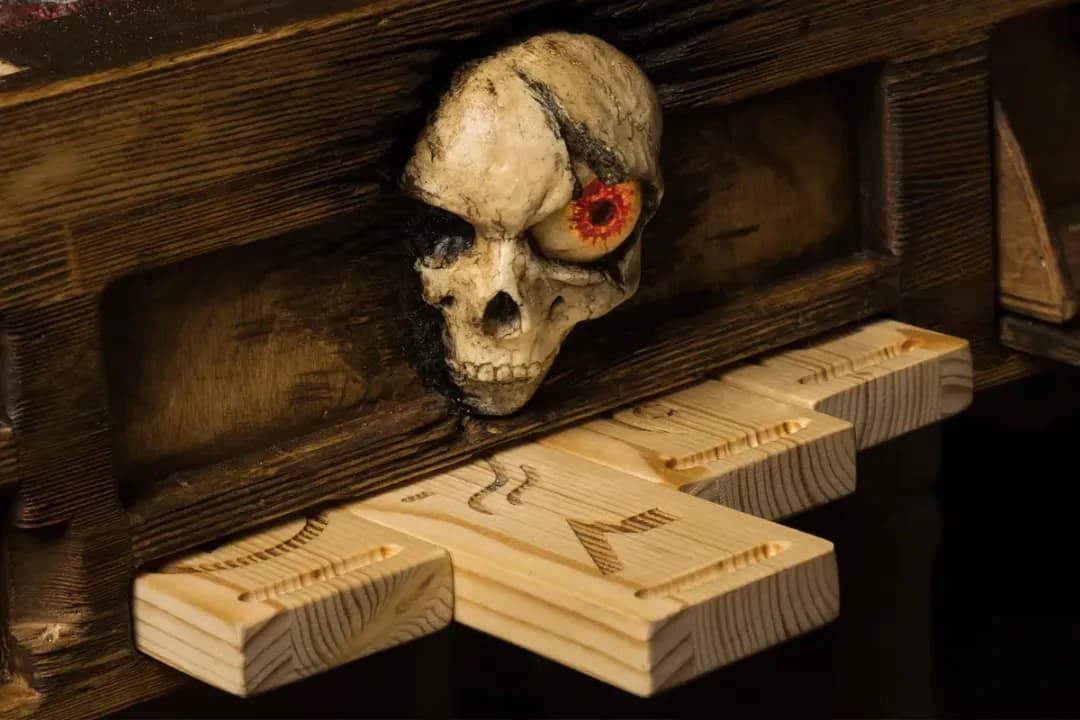
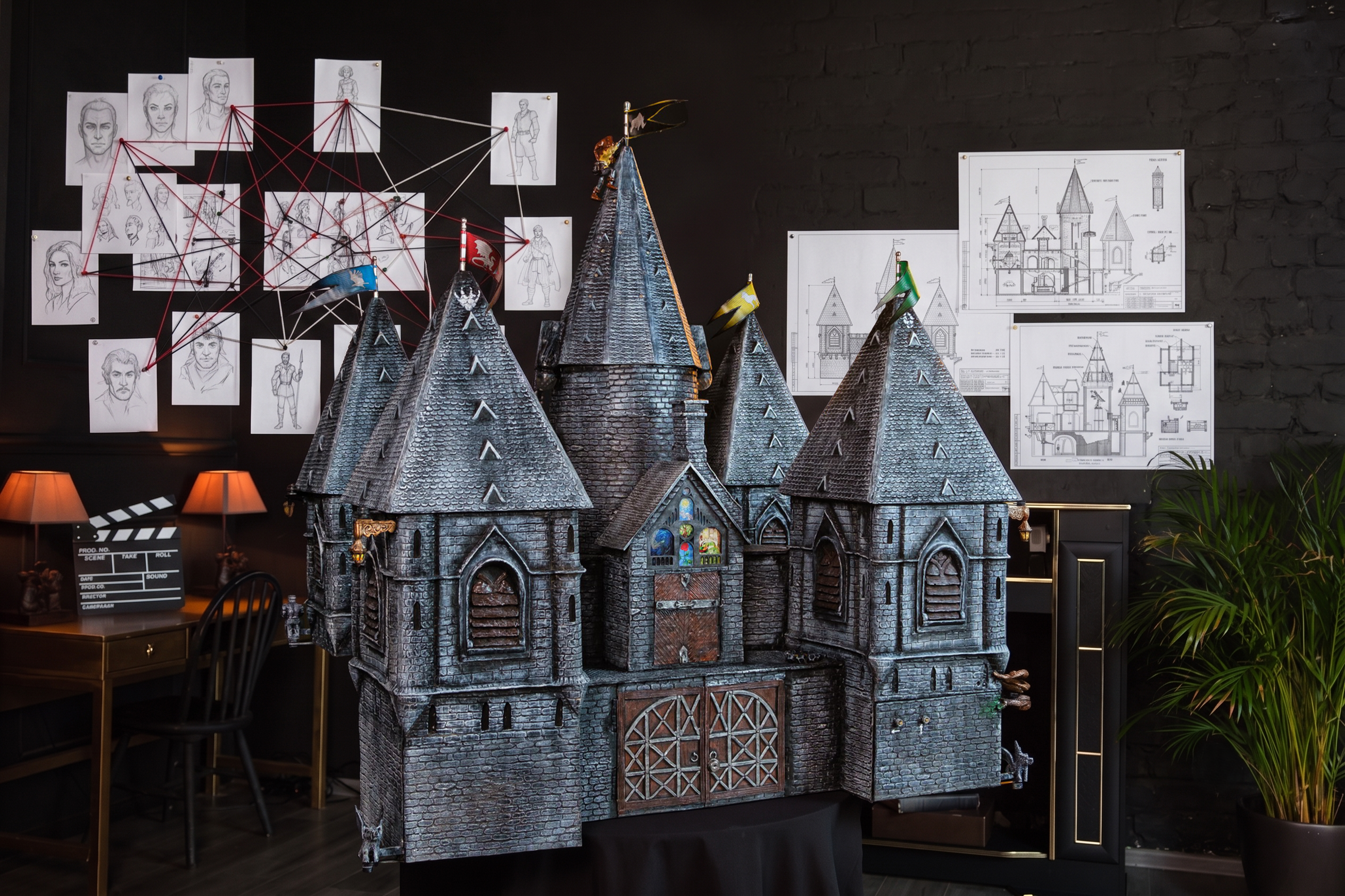
The floor, walls and ceiling of every zone are a plastic relief. But all of it was sculpted by hand in modeling clay first: every room, every external device, the entire castle. Then cast in plastic and painted by an artist.
That is how we got a level of detail you cannot buy off the shelf.
That was a lot of modeling clay.
The plastic is only the part you can see
From the outside it looks like the whole job is clay, plastic and an artist’s paintwork. In reality that is just the shell. Behind the walls of every zone is its own electronics, and designing that took no less time than sculpting and painting the entire castle.
Each room has its own chain: sensors register what the player did - placed an object, turned the platform, completed a sequence; the controller checks it against the script; light, sound and mechanics deliver the payoff. With Cerberus there is also a platform rotation-speed sensor; with Elspeth, a sensor for the correct order of bottles in the groove. And all of it has to fire in the same instant as what the player sees and hears - half a second of lag destroys the illusion that the zone is alive. Building it so that fifteen different zones run in sync and without failures for years, not months is a separate engineering problem, entirely unrelated to how the zone looks.

There is one more layer a guest will never see - the drawings. Every plywood and metal part holding a room together starts as a drawing made for specific fixings and a sequence a crew can actually follow on site. Without precise drawings, assembling one castle would stretch into months of the venue’s time instead of a month - and the client is the one who ends up paying for that. The more precise the drawing, the faster the kit goes together and the lower its final price.
Then there is sound. Every story beat has its own music, rather than one theme for a whole zone: one mood when the players first walk in on Elspeth, and a completely different one when Cerberus starts to stir. The music was chosen for the moment in the story, the way a film soundtrack shifts within a single scene as its tension changes.
The guest hears a character’s voice and music that matches the mood. They never see the drawing or the line of code that made it possible in the first place.
And the least visible layer of all - the code. All fourteen characters have been re-recorded in several languages, and behind their lines sits an enormous body of logic that remembers what the player has already done in other zones and changes the characters’ hints and reactions accordingly as the game goes on. That is exactly the job a live staff member used to do in a room - except a staff member could never run fifteen zones at once, and the code can.
Why there ended up being more mechanics, not fewer
This is usually where people ask: how did a smaller space fit more mechanics than a big escape room?
The answer is fairly boring. In a conventional escape room the mechanics are spread thin across a large floor area - you walk from one to the next through empty space. We packed them tightly.
The mechanic itself does not change when you shrink it. The thinking is the same, the satisfaction of solving it is the same. And a story has no size at all: intimate films and good books work with no sets whatsoever.
The prototype was not the hard part
Elon Musk put it better than I could: “Prototypes are easy. Production and operations are hard.”

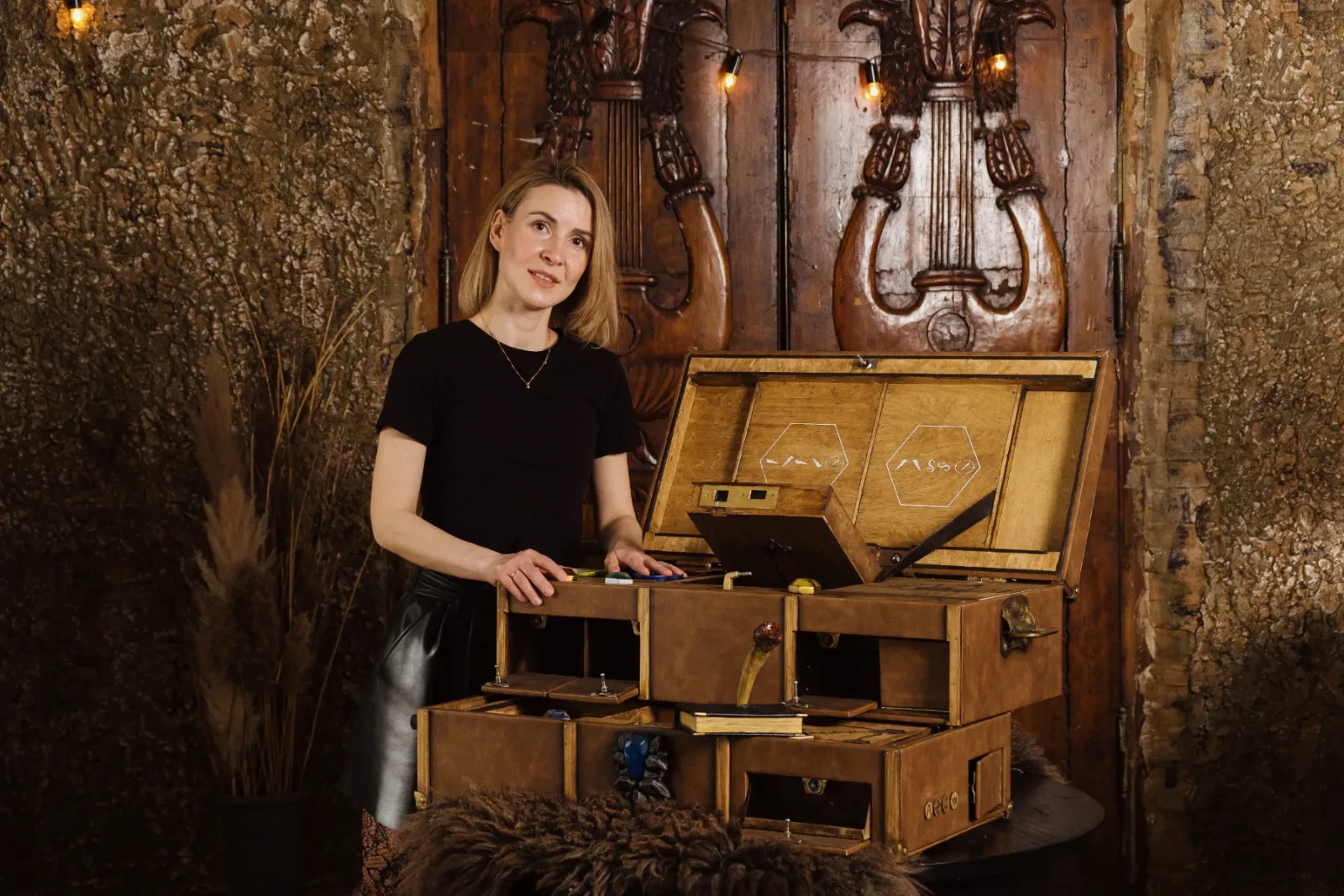
Building one working Castle is an engineering problem. Making it repeatable from kit to kit, assemblable on site, repairable and able to run at a client’s venue overseas without us - that is a different job, and it took far longer.
Some tasks cannot be done alone
When a group plays an escape room, one or two people usually solve everything while the rest watch. Sometimes not because they do not want to - the more energetic ones simply get there first, and the others never get their turn.
So some of the puzzles in the Castle can only be solved by two people. Not “can be done by two” - there is no other way.

But forcing everyone to be paired up all the time is a bad idea. Some people want to crack a couple of puzzles and then just walk around and watch, and that is perfectly fine.
There are also parallel games. At two points in the story the group can split into four teams of one or two people, each working on its own thing. The active zones are lit up yellow on the map at that moment. Playing in parallel was something our clients asked for a lot - for the pace it gives.
The fast-changing scenery is no accident
We live in the age of social media, and it has trained us all into clip thinking: short fragments, vivid images, fast switching. That is how everything popular is built now - films, cartoons, games, even some forms of teaching.
In the Castle, characters and zones change quickly over a single playthrough. You do not spend forty minutes in one set. That also extends the room’s commercial life for the owner: the guest remembers not one image but a dozen and a half.
Why our advertising does not say “30 puzzles!”
Fifteen zones and four external games are what we count, not puzzles. Many of those zones hold more than one puzzle, plus there are separate tasks outside the castle itself. Counted honestly, it comes to thirty. But we do not wave that number around, and that is deliberate.
Escape rooms compete with each other on puzzle counts. We are selling something else: quality time spent with the people closest to you, privately, with no strangers in the room.
There are a lot of puzzles not because we were chasing a number. There are a lot of them because the story demanded it.
Which is why it is a “movie,” not a “puzzle room”
Those two people on the video call were not solving puzzles. They were inside a story, and the puzzles turned out to be the way to move it forward. That was the whole design intent: a story-driven escape room where the puzzles serve the story, not the other way around.
You can hear the voices of Elspeth, Boris and the rest of the characters on the Castle page - you can also see what the rooms look like from the inside there.
See the full lineup
Which escape room fits your venue?
Explore the products