The Portable Format: Inside Wizard’s Chest and Dead Man’s Chest
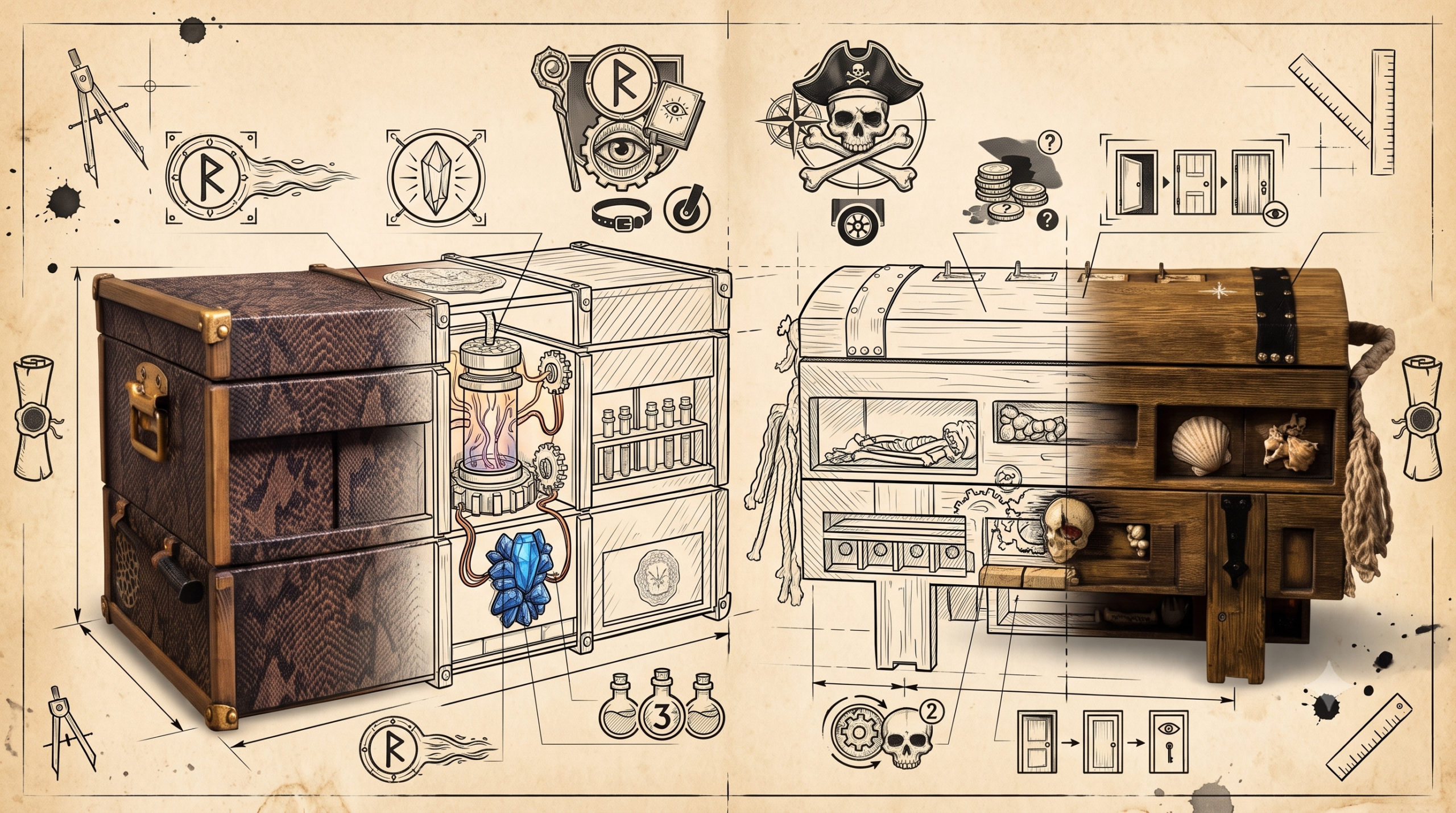
Ruth Curtis, owner of Rushden Escape Rooms in England, took the Wizard’s Chest to a school science and technology fair. Kids aged nine to eleven were solving puzzles right there in the assembly hall - a space that, an hour earlier, held nothing but a stage and rows of chairs.
By evening the chest was already riding home in the trunk of her car - off to the next venue, the next group of players.
This isn’t some side use case. It’s the entire reason the chest is built the way it is. Chronicles of the Living Castle gets installed on site, and it stays there for years. The chest was designed from the outset to leave.
A different format, not a miniature Castle
Wizard’s Chest and Dead Man’s Chest are sometimes mistaken for a scaled-down version of the Castle. They’re not. The Castle solves one problem - being the anchor attraction of a venue, the thing players come to. The chest solves another: a private, hour-long game for two or three people that fits into 54-86 sq ft and can, at any moment, end up somewhere entirely different from where it stood yesterday.
Portability here isn’t a bonus feature, it’s the original design brief. Every decision inside - from the weight to the type of locks on the hidden compartments - was made knowing the chest would be loaded into a car, rattled down the road, and switched on somewhere that may not even have a power outlet.
Designed to fit an ordinary car trunk
Dead Man’s Chest weighs 29 kg, Wizard’s Chest 28 kg. One adult man can carry it alone using the handles on either side. It slides into the trunk of any passenger car without trouble.

That’s no accident. During development we deliberately took the most common trunk size on the market and built the chest’s dimensions around it - rather than fitting the car to a finished device.
If the chest has been prepped in advance and the props are already laid out in their compartments, setup time at a new location is zero: put it down, switch it on, play. If you need to reload the game beforehand, that takes a minute.
What we broke before the chest became road-ready
All the electronics inside are screwed down, connections sealed with hot glue, cables secured with zip ties - that’s the baseline. But before we arrived at the current version there were a few failures, and they showed up on the road rather than on the test bench back at the factory. Here are two of them.
On the earliest chests, the batteries sat a little loose in their compartments. We borrowed a trick from the automotive world: they’re now held firmly against the housing by rubber straps.

Even earlier, connectors on the first chests would sometimes work their way out of their sockets after a trip - vibration shook them loose. Every connector has been secured with an extra bead of hot glue ever since.
Neither fix came off a drawing board - both came out of real use. Specific clients who genuinely haul these chests to off-site events found the weak points before we did.
The battery you can’t ship across a border
The chest has a dedicated battery bay - but we don’t fit the battery at the factory. The reason is boring and practical: customs holds up shipments containing batteries, and we’d rather not create border headaches for our clients. So the client buys the battery locally - a standard, widely available size you can pick up in any city.
Depending on the capacity you choose, a charge lasts 6-10 hours of continuous play with no outlet.
To make that charge go as far as possible, we dropped electromagnetic locks on the compartment doors in favor of electromechanical ones. An electromagnet holds a door shut by drawing current continuously. An electromechanical lock fires a single pulse at the moment of opening - under half a second - and draws nothing at all the rest of the time. On battery life, the difference is substantial.
The game runs with no internet
The game itself needs no internet. The chest broadcasts its own Wi-Fi network; a staff member connects to it from their phone and runs the game - start, hints, language, sound. If there’s no connectivity on site at all, that’s no obstacle to playing the game through.

The internet is there for something else - remote diagnostics and updates, the same level of technical support our permanent installations get. It’s simply that during an off-site event with no connection, that option is temporarily unavailable.
Where it’s been so far
The most detailed example is the one we started with: Ruth Curtis. Alongside her permanent venue, she uses the Wizard’s Chest as a fully mobile solution - school fairs, corporate events, town events. We’ve told her story in full - including a direct quote about how the kids at that STEM fair worked as a team, argued with each other, and found the clues inside the chest.
Another of our clients, in Belgium, takes the Wizard’s Chest to local fetes on a regular basis - and it was that chest, in real service, that surfaced some of the weak points in the connectors and battery mounting described above. Field use turned out to be a more honest tester than any bench.
The mobile format is becoming a growing practice across the escape room industry in general: a compact version of the game increasingly travels to fairs and events as a way to funnel new players back to the permanent venue, instead of simply waiting for people to discover it on their own.
Hints work with no host in the room
Like the Castle, the chests have a built-in hint system - no game master required at all. In the Wizard’s Chest the player touches a crystal on the housing; in Dead Man’s Chest, an eye on the skull. The first touch is a nudge toward what to do next. If the player is still stuck, a second touch gives the answer outright.
Same principle as the Castle: the hint is understated to exactly the degree that the player still believes they worked it out themselves. People should walk out of the game feeling like the hero, not like someone who had to be told.
The puzzles of Wizard’s Chest
The leather picture on the lid
Set into the chest’s lid is a leather picture. At first glance it makes no sense, but look closely and numbers emerge from it: mirrored, disguised as decorative shapes. Lower down in the same image is the sequence in which those numbers must be touched with a magic wand. Every touch is answered by a magical sound. Get the order right and the lid opens, the music changes, and the narrator carries the story onward.

From that moment to the end of the game, the wizard character speaks to the players from a world of magic where good wizards are locked in battle with an evil sorcerer. The only way to stop him is to destroy the relics the wizards hid inside the chest. Time is running short, and the players have to find them all before it does.
Duel with the serpent

The final stage is a battle with the serpent the evil sorcerer has taken form as. Players have to memorize the sequence of its attack - different relics light up one after another around the serpent - and repeat it back in exactly the same order. Next to the serpent, on the chest housing, are two life bars: the player’s and the serpent’s. A deflected attack costs the serpent a life; a mistake costs the player one. You can genuinely lose here and start the battle over. All of it is carried by sound effects, battle music and the character’s lines. Once the serpent is beaten, the players retrieve the final crystal - the one that resurrects - to send back to the good wizards.
The puzzles of Dead Man’s Chest
Eight drums and a poem
The lid carries eight rotating drums, each with its own set of symbols: a sun, a ship, the sea, a seagull and others. Players are handed a piece of leather with a poem on it. Solve the poem and you work out which image belongs on which drum, so the order matches the lines of the verse.

All the while, the story is told by the ghost of a pirate trapped inside the chest: he once picked up a totem and, strangely enough, found himself sealed in. He asks the players to help him get out, and feeds them hints as they go, since he knows a great deal about these puzzles himself. His voice is old - the pirate has been in that chest a very long time. When the drums line up correctly, the lid opens with sound effects and a change of music.
The island of the green frog

Inside the chest is a level with three LED rings that players rotate using frog-shaped switches. As they turn, LEDs from one ring get picked up by the next - it takes attention and a bit of thinking through the logic. Addressable LED strips and sound make this one bright and genuinely absorbing.
The compass and the coin
At a certain point in the game, players find a real pirate’s compass in their hands. Place it in the right spot and the chest’s magnetic field swings the needle - and wherever it points, that’s where the coin goes. The puzzle isn’t hard to solve, but it’s satisfying, and it yields the fourth cube for the next stage.

The cubes travel with the players through the whole game: first they have one, then more, and the tasks can only be solved with them. Inside the cubes are magnets and RFID tags, and roughly half the faces end up being a working side that gets used somewhere in the game.
Why these two stories
Dead Man’s Chest was originally built to a specific client’s request - they asked for a pirate theme, so we made one. From version to version we refined and improved it: cutting weight, adding electronics and automation, more voice-over languages, a full control panel. That’s how it became the product it is today - not an original grand plan, but the result of several iterations shaped by real demand.
Wizard’s Chest came about because magic was, and remains, a reliably popular theme, and the housing we’d already developed could serve as a ready-made platform - rather like the way one platform underpins several models at a car manufacturer. That’s how a second chest was born on the same engineering base.
How the chest differs from the Castle, engineering-wise
The chest is more compact and was designed specifically to travel - but it has one trick players never see coming. Just when it seems the chest has been solved and everything is clear, the tiers slide apart: the upper level moves aside and three more levels of the game open up below. Clients don’t expect it, and the surprise lands almost every time.
Inside is the same technical stack as the Castle: controllers, a browser-based control panel, remote support access over the internet, voice-over in multiple languages. There are physically fewer puzzles than in the Castle - but that’s not a shortfall, it’s the scale of the format: the chest is honestly built for an hour with two or three people in 54-86 sq ft.
Will it survive frequent moves?
The chest’s frame is plywood, the skin is furniture-grade panel, and the housing is solid. The electronics inside are screwed down and the connectors sealed with hot glue. A repair kit is included. The one thing the chest won’t survive is water: there’s no protection against it, which is worth bearing in mind if you’re planning to run the game outdoors.
A chest that ends up back in the trunk come evening isn’t an exception to the rule - it’s precisely what it was designed for from the very first drawing. For more on how the games themselves work, see the Wizard’s Chest and Dead Man’s Chest pages.
See the full lineup
Which escape room fits your venue?
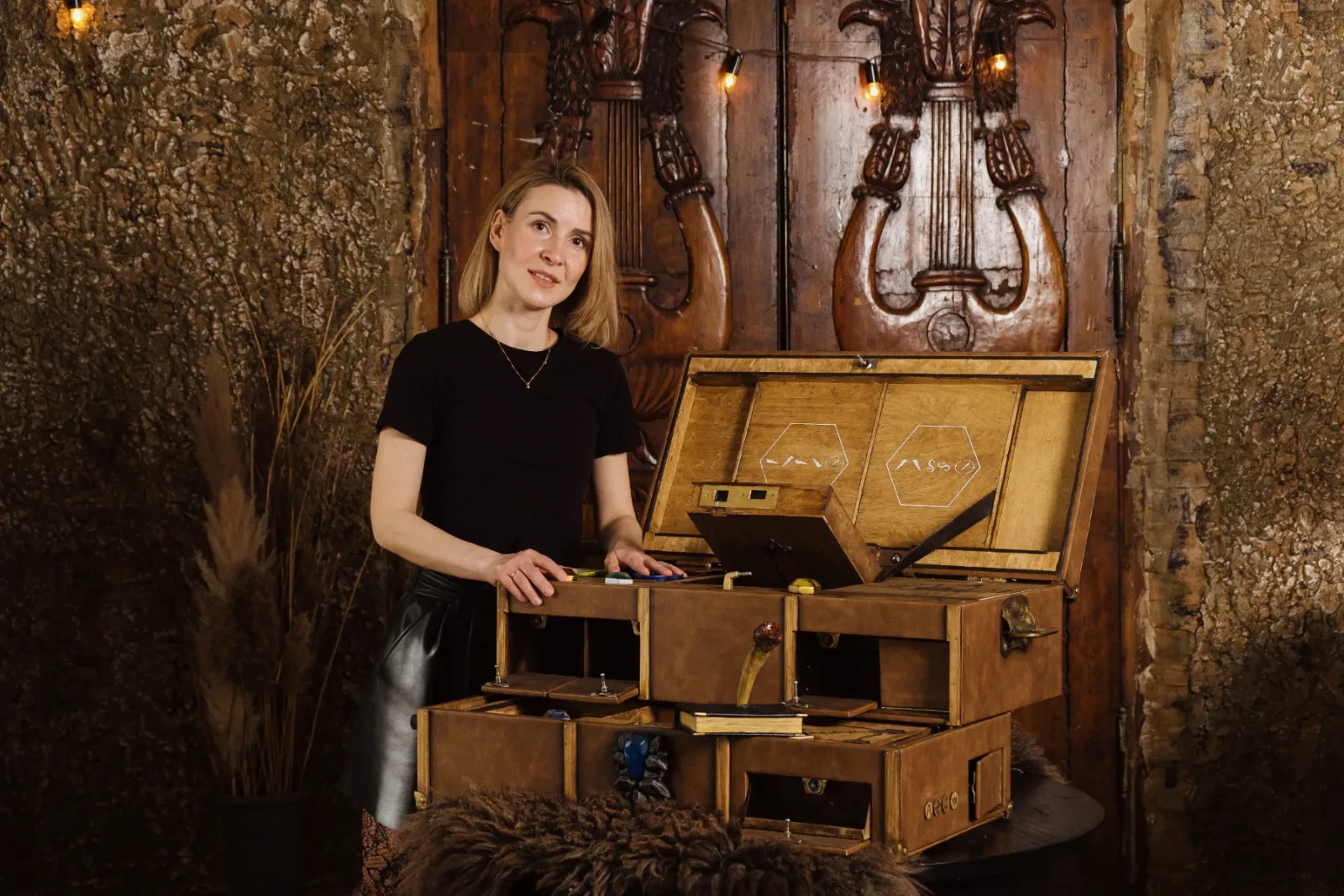 Wizard's ChestA private adventure for pairs, about an hour inside a story.
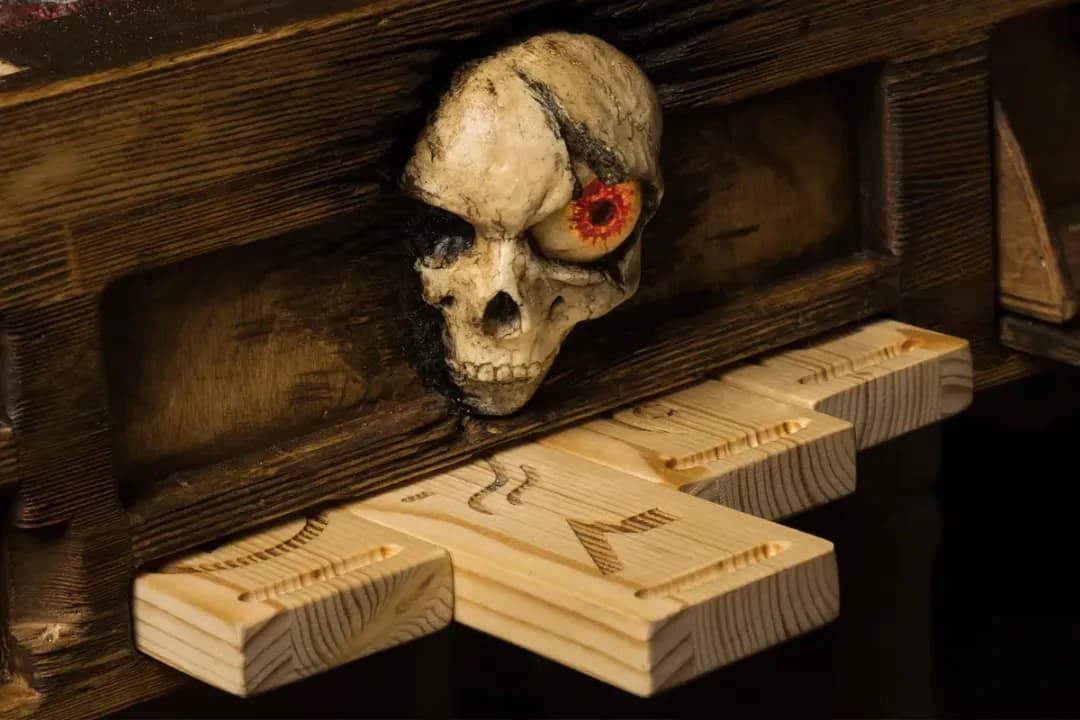 Dead Man's ChestA private pirate adventure for two, about an hour inside a story.
 Chronicles of the Living CastleA magical world a group of guests steps into together, for a cozy, one-of-a-kind adventure.